

Three Phase Sectionalizer Market Set for Steady Growth as Utilities Modernize Power Distribution Infrastructure
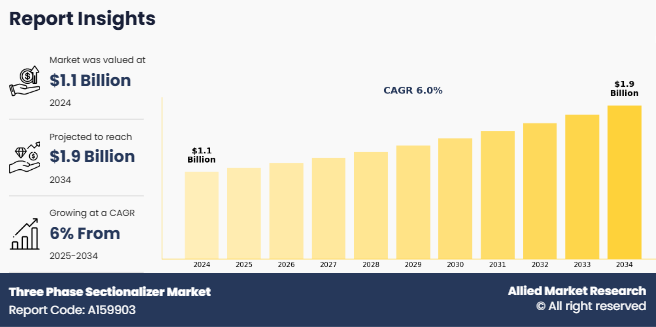
Three Phase Sectionalizer Market is expanding as utilities invest in smart grids, renewable energy integration, and advanced fault isolation technologies.
Growing demand for reliable power distribution, grid automation, and renewable energy projects is driving the global Three Phase Sectionalizer Market.”
WILMINGTON, DE, UNITED STATES, June 16, 2026 /EINPresswire.com/ -- — Allied Market Research
According to industry estimates, the global Three Phase Sectionalizer Market size was valued at approximately $1.1 billion in 2024 and is projected to reach nearly $1.9 billion by 2034, registering a CAGR of around 6.0% during the forecast period. Growing investments in smart grid infrastructure, digital substations, automated distribution networks, and renewable energy projects continue to create strong opportunities for market expansion.
The Three Phase Sectionalizer Market is witnessing notable growth as power utilities across the world invest heavily in grid modernization, renewable energy integration, and advanced fault management technologies. As electrical networks become increasingly complex due to distributed energy resources, electric vehicle charging infrastructure, and growing electricity demand, utilities require smarter solutions that enhance reliability and reduce outage durations.
Download PDF Brochure: https://www.alliedmarketresearch.com/request-sample/A159903
A three-phase sectionalizer serves as a critical protection device within medium-voltage distribution systems. It works alongside reclosers and circuit breakers to identify faulted sections and isolate them without disrupting power supply across the entire network. This capability has become increasingly valuable as utilities strive to improve customer service, maintain grid stability, and meet regulatory reliability standards.
The increasing adoption of intelligent electrical equipment, coupled with rising demand for uninterrupted electricity supply across industrial, commercial, and residential sectors, is expected to strengthen market momentum throughout the coming decade.
Market Overview
The Three Phase Sectionalizer Market forms an important segment within the broader power distribution automation industry. These devices improve network resilience by automatically isolating faulted portions of electrical circuits while allowing unaffected sections to continue operating.
Modern utilities face increasing challenges associated with aging infrastructure, renewable energy integration, extreme weather events, and growing power consumption. Traditional fault management methods often require manual intervention, leading to longer outage durations and higher operational costs.
Three-phase sectionalizers address these challenges by enabling automated fault detection and isolation. Their ability to communicate with reclosers and smart distribution systems enhances operational efficiency while reducing restoration times.
The market is benefiting from several long-term trends including:
Expansion of renewable energy installations
Growth of smart grid projects
Rising investments in power transmission and distribution
Increasing urbanization and industrialization
Adoption of digital utility management systems
Modernization of aging electrical infrastructure
As governments and utilities prioritize grid resilience and energy reliability, demand for advanced sectionalizing equipment is expected to increase significantly.
Market Dynamics
Rising Need for Reliable Power Distribution
Power outages can result in substantial economic losses for industries, commercial establishments, and public infrastructure. Utilities are increasingly deploying sectionalizers to minimize outage durations and improve service reliability.
Three-phase sectionalizers help isolate faulted segments quickly, ensuring that only affected portions of the network experience interruptions. This capability enhances overall grid performance and customer satisfaction.
Expansion of Renewable Energy Networks
Renewable energy integration is transforming electrical distribution systems. Solar farms, wind projects, battery storage facilities, and distributed generation systems introduce bidirectional power flows that require advanced protection mechanisms.
Sectionalizers support these modern grid configurations by facilitating efficient fault isolation and maintaining system stability even under fluctuating generation conditions.
Growing Focus on Smart Grid Development
Smart grid initiatives worldwide are driving the deployment of intelligent electrical equipment. Utilities increasingly seek automated devices capable of real-time communication and remote operation.
Three-phase sectionalizers fit naturally within smart distribution architectures, enabling utilities to improve operational visibility and automate fault management processes.
Market Drivers
Renewable Energy Integration Supporting Market Expansion
One of the strongest growth drivers for the Three Phase Sectionalizer Market is the rapid integration of renewable energy resources into distribution networks.
Solar and wind facilities create dynamic power flows that differ from traditional centralized generation models. Utilities require advanced protection systems capable of responding to changing network conditions while maintaining reliability.
Three-phase sectionalizers provide automatic fault isolation capabilities that help utilities manage distributed generation effectively. Their role becomes increasingly important as renewable energy penetration continues to rise globally.
Distribution Automation Investments
Utilities are investing heavily in automated distribution systems to improve efficiency and reduce operational expenses.
Automation technologies enable faster fault identification, remote switching, and real-time network monitoring. Sectionalizers contribute significantly to these capabilities by serving as intelligent field devices within automated distribution networks.
Infrastructure Modernization Programs
Many countries are upgrading aging electrical infrastructure to meet future energy demands. Replacement of outdated protection devices with intelligent sectionalizers represents a key component of these modernization initiatives.
Government funding and utility investment programs are expected to create long-term demand for advanced sectionalizing equipment.
Market Restraints
High Initial Installation Costs
Despite their operational benefits, three-phase sectionalizers involve significant upfront investment. Equipment costs, communication systems, software integration, and installation expenses can create barriers for some utilities.
Budget constraints may delay deployment projects, particularly in developing regions with limited infrastructure funding.
Integration Complexity
Integrating sectionalizers into existing distribution systems requires careful planning and technical expertise. Utilities must ensure compatibility with reclosers, SCADA systems, communication networks, and protection schemes.
These complexities can increase project timelines and implementation costs.
Maintenance and Training Requirements
Advanced electronic sectionalizers require specialized maintenance and skilled personnel. Utilities may need additional training programs to ensure efficient operation and troubleshooting of modern systems.
Market Opportunities
Digital Grid Transformation
Digital transformation initiatives across the utility sector present major opportunities for market participants. Utilities increasingly seek intelligent devices capable of supporting real-time monitoring, predictive maintenance, and automated decision-making.
Manufacturers that offer advanced communication-enabled sectionalizers are well-positioned to capitalize on these trends.
Growth of Distributed Energy Resources
The expansion of distributed energy resources creates substantial demand for enhanced protection and control solutions.
As solar rooftop systems, battery storage installations, and microgrids become more prevalent, utilities require sectionalizers capable of managing increasingly complex distribution networks.
Emerging Economies Infrastructure Development
Developing economies continue investing in transmission and distribution infrastructure to improve electricity access and reliability.
These investments create significant opportunities for sectionalizer manufacturers targeting rapidly growing energy markets.
Technology Analysis
Technological advancements are transforming sectionalizer capabilities and expanding their applications.
Modern three-phase sectionalizers incorporate:
Remote monitoring functionality
Digital communication protocols
Smart sensors
Fault current analytics
Real-time diagnostics
SCADA integration
Predictive maintenance capabilities
The integration of IoT technologies and advanced analytics enables utilities to monitor network conditions continuously and respond proactively to potential issues.
Artificial intelligence and machine learning applications are also beginning to influence fault prediction and grid optimization strategies, further enhancing the value proposition of intelligent sectionalizers.
Procure This Report (382 Pages PDF with Insights, Charts, Tables, and Figures): https://www.alliedmarketresearch.com/three-phase-sectionalizer-market/purchase-options
Industry Trends
Increased Adoption of Smart Utilities
Utilities worldwide are transitioning toward digital operations. Smart utility initiatives emphasize automation, remote asset management, and data-driven decision-making.
Three-phase sectionalizers are increasingly becoming standard components within these modernization programs.
Expansion of Renewable Power Infrastructure
Global renewable energy investments continue accelerating. Utilities must upgrade protection systems to accommodate distributed generation and variable energy sources.
This trend is expected to support sustained demand for sectionalizing technologies throughout the forecast period.
Enhanced Grid Resilience Requirements
Extreme weather events and growing electricity dependence have increased focus on grid resilience.
Utilities are deploying sectionalizers to improve fault isolation capabilities and reduce outage impacts, making resilience enhancement a major market driver.
What is a Sectionalizer?
A common question among utility professionals and energy stakeholders is: What is a sectionalizer?
A sectionalizer is a protective switching device used in electrical distribution systems to automatically isolate faulted sections of a feeder. Unlike circuit breakers or reclosers, sectionalizers do not interrupt fault current directly. Instead, they count fault interruptions performed by upstream protective devices and open when the circuit becomes de-energized.
This coordinated operation allows utilities to isolate permanent faults while maintaining service continuity across healthy sections of the network.
Sectionalizers significantly improve reliability, reduce outage durations, and support automated distribution system operations.
Three Phase Sectionalizer Market Size and Growth Outlook
The three phase sectionalizer market size is expected to expand steadily over the next decade due to growing investments in power distribution infrastructure and renewable energy integration.
Utilities increasingly recognize the operational benefits of intelligent fault isolation technologies. Improvements in automation, communication capabilities, and system reliability continue strengthening the business case for sectionalizer deployment.
Rising electricity consumption, infrastructure modernization programs, and smart grid investments are expected to sustain healthy market growth through 2034.
Three Phase Recloser Market and Three Phase Reclosers Market Relationship
The three phase recloser market and three phase reclosers market are closely connected to sectionalizer deployment.
Reclosers serve as primary fault interruption devices, while sectionalizers operate in coordination with them to isolate persistent faults. Together, these devices form a critical protection strategy within modern distribution systems.
As utilities invest in automated fault management solutions, demand for both reclosers and sectionalizers is expected to rise simultaneously.
The combined adoption of these technologies improves system reliability, minimizes customer outages, and enhances operational efficiency.
Single Phase Recloser Market Influence
Growth in the single phase recloser market also contributes indirectly to sectionalizer demand.
Many utilities deploy a combination of single-phase and three-phase protection equipment depending on network design and application requirements. Increased investment in distribution automation often includes upgrades across multiple protective device categories.
This broader modernization trend supports overall expansion of the protection equipment industry.
Three Phase Residential Voltage Regulator Market and Grid Stability
The three phase residential voltage regulator market highlights growing emphasis on power quality and voltage management.
As residential electricity consumption increases and distributed generation expands, utilities must maintain voltage stability across distribution networks.
Sectionalizers complement voltage regulation systems by ensuring rapid fault isolation and supporting overall grid performance.
Together, these technologies contribute to more reliable and resilient electricity delivery.
Regional Analysis
North America Three Phase Sectionalizer Market
The North America three phase sectionalizer market remains one of the most established regional markets.
Utilities across the United States and Canada continue investing in smart grid projects, renewable integration, and distribution automation initiatives.
Aging infrastructure replacement programs and stringent reliability requirements further support market growth throughout the region.
Europe Three Phase Sectionalizer Market
The Europe three phase sectionalizer market is benefiting from extensive renewable energy deployment and grid modernization initiatives.
European countries are investing heavily in digital energy infrastructure, distributed generation management, and decarbonization strategies.
Advanced protection technologies play a critical role in supporting these objectives.
Asia Pacific Three Phase Sectionalizer Market
The Asia Pacific three phase sectionalizer market is expected to experience the fastest growth during the forecast period.
Rapid urbanization, industrial expansion, renewable energy investments, and increasing electricity demand are driving infrastructure development across the region.
Countries such as China, India, Japan, Australia, and Southeast Asian nations continue investing in modern distribution networks, creating substantial opportunities for sectionalizer manufacturers.
Segment Analysis
Voltage Segment Analysis
The 16 kV to 27 kV segment is expected to maintain strong growth due to its widespread use in medium-voltage distribution networks.
Utilities increasingly rely on sectionalizers within this voltage range to improve network reliability and support automation initiatives.
Control Type Analysis
Resettable electronic sectionalizers are gaining popularity because of their intelligent operation and automatic reset capabilities.
These devices reduce maintenance requirements while improving fault management efficiency.
Application Analysis
Power plant applications continue generating significant demand as operators seek reliable fault isolation and network protection solutions.
The growing complexity of modern power generation facilities further strengthens adoption.
End-Use Analysis
Commercial and industrial sectors increasingly depend on uninterrupted electricity supply.
Sectionalizers help minimize operational disruptions by quickly isolating faults and maintaining service continuity.
Competitive Landscape
The Three Phase Sectionalizer Market features several prominent manufacturers focused on innovation, automation, and grid modernization technologies.
Key companies include:
ABB Ltd.
Eaton Corporation
Hubbell Incorporated
Tavrida Electric
G&W Electric
Schneider Electric
S&C Electric Company
NOJA Power
These companies continue investing in smart technologies, communication capabilities, and automation features to strengthen their market positions.
Investment Analysis
Investment activity within the sector is increasing as utilities pursue grid modernization and renewable integration goals.
Key investment areas include:
Smart distribution networks
Renewable energy connectivity
Digital substations
Automated fault management
Remote monitoring systems
Grid resilience enhancement
Public and private sector funding programs are expected to support continued infrastructure upgrades worldwide.
Regulatory Landscape
Governments and regulatory agencies increasingly emphasize grid reliability, resilience, and renewable energy integration.
Policies supporting smart grid development, energy transition objectives, and utility modernization programs are creating favorable conditions for sectionalizer deployment.
Regulatory incentives aimed at improving reliability metrics further encourage investment in automated protection technologies.
Future Outlook
The future of the Three Phase Sectionalizer Market appears highly promising. Rising renewable energy penetration, growing electricity demand, smart grid investments, and digital transformation initiatives are expected to sustain long-term growth.
Emerging technologies such as artificial intelligence, advanced analytics, IoT connectivity, and predictive maintenance platforms will likely enhance sectionalizer functionality and expand their role within modern electrical networks.
Utilities will continue prioritizing solutions that improve reliability, reduce outage durations, and optimize grid performance.
Get a Customized Research Report: https://www.alliedmarketresearch.com/request-for-customization/A159903
Conclusion
The Three Phase Sectionalizer Market is positioned for sustained growth as utilities worldwide accelerate investments in smart grids, renewable energy integration, and resilient power distribution infrastructure. These intelligent protection devices play a critical role in improving fault isolation, minimizing service disruptions, and enhancing overall grid performance.
Growing adoption of automated distribution systems, expanding renewable energy capacity, and increasing demand for reliable electricity supply will continue supporting market expansion over the coming decade. While installation costs and integration challenges remain considerations, technological advancements and utility modernization efforts are expected to outweigh these obstacles.
As power networks evolve toward smarter and more decentralized architectures, three-phase sectionalizers will remain essential components in building efficient, reliable, and future-ready electrical distribution systems.
Trending Reports in Energy and Power Industry:
Three Phase Sectionalizer Market
https://www.alliedmarketresearch.com/three-phase-sectionalizer-market-A159903
Dry Type Transformer Market
https://www.alliedmarketresearch.com/dry-type-transformer-market
Cast Resin Dry Type Transformer Market
https://www.alliedmarketresearch.com/cast-resin-dry-type-transformer-market-A15001
U.S. Cast Resin Transformer Market
https://www.alliedmarketresearch.com/us-cast-resin-transformer-market-A13102
KSA and MEA Dry Type Transformer Market
https://www.alliedmarketresearch.com/ksa-and-mea-dry-type-transformer-market-A325393
Transformer Bushings Market
https://www.alliedmarketresearch.com/transformer-bushings-market-A15871
Instrument Transformers Market
https://www.alliedmarketresearch.com/instrument-transformers-market-A10491
Transformers Market
https://www.alliedmarketresearch.com/transformers-market-A06374
Renewable Energy Transformer Market
https://www.alliedmarketresearch.com/renewable-energy-transformer-market-A74845
Solid State (Smart) Transformer Market
https://www.alliedmarketresearch.com/solid-state-transformer-market
Gas Insulated Transformer Market
https://www.alliedmarketresearch.com/gas-insulated-transformer-market-A15966
Amorphous Core Power Transformers Market
https://www.alliedmarketresearch.com/amorphous-core-power-transformers-market-A149775
Distribution Transformer Market
https://www.alliedmarketresearch.com/global-distribution-transformer-market-A190577
Voltage Transformer Market
https://www.alliedmarketresearch.com/voltage-transformer-market-A15993
Power Transformer Market
https://www.alliedmarketresearch.com/power-transformers-market
Aluminum Bare Wire Conductor Market
https://www.alliedmarketresearch.com/aluminum-bare-wire-conductor-market-A325757
About Us
Allied Market Research (AMR) is a full-service market research and business-consulting wing of Allied Analytics LLP based in Portland, Oregon. Allied Market Research provides global enterprises as well as medium and small businesses with unmatched quality of "Market Research Reports" and "Business Intelligence Solutions." AMR has a targeted view to provide business insights and consulting to assist its clients to make strategic business decisions and achieve sustainable growth in their respective market domain.
Pawan Kumar, the CEO of Allied Market Research, is leading the organization toward providing high-quality data and insights. We are in professional corporate relations with various companies and this helps us in digging out market data that helps us generate accurate research data tables and confirms utmost accuracy in our market forecasting. Each and every data presented in the reports published by us is extracted through primary interviews with top officials from leading companies of domain concerned. Our secondary data procurement methodology includes deep online and offline research and discussion with knowledgeable professionals and analysts in the industry.
David Correa
Allied Market Research
+ + + + + + + + + + + + + +1 800-792-5285
email us here
Visit us on social media:
LinkedIn
Facebook
YouTube
X
Legal Disclaimer:
EIN Presswire provides this news content "as is" without warranty of any kind. We do not accept any responsibility or liability for the accuracy, content, images, videos, licenses, completeness, legality, or reliability of the information contained in this article. If you have any complaints or copyright issues related to this article, kindly contact the author above.
